
Can Indian companies compete internationally while contributing to a resilient and technologically robust aerospace bearing ecosystem?
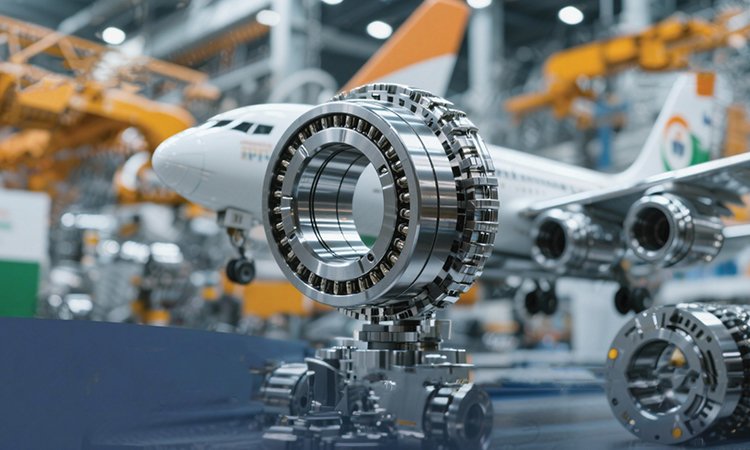
Bearings may be small components, but in the aerospace and aviation sector they play an outsized role—ensuring reliability, safety, and performance in flight-critical systems. With rising demands for precision, light weighting, and sustainability, bearing suppliers are being called upon not just as component manufacturers, but as engineering partners.
Behind every successful aerospace program lies a network of dedicated partners. By combining deep engineering know-how with a commitment to innovation and close collaboration, VAM is helping its customers achieve breakthroughs in performance, safety, and sustainability—proving that true progress in aviation is always a shared journey.
In this conversation, BEARING REVIEW explores how VAM CONSULTING, deeply engaged in the aerospace bearing industry, contributing to global sales and marketing, application engineering, design and development, reverse engineering, indigenization and certifications, defect investigations, performance analysis, sourcing, and even M&A and joint ventures is driving innovation, customization, and lifecycle support to meet the sector’s exacting requirements. – P.K. Balasubramanian, Chief Editor, BR.
1Q: Could you share your professional journey in the bearing industry and how you became an aerospace bearing specialist?
I have spent over 25 years in the Aerospace & Defense industry, gaining extensive techno-commercial exposure across the entire value chain—working with OEMs, system integrators, Tier 1/2/3 manufacturers, MROs, subcontractors, and engineering service providers. Since 2011, I have been deeply engaged in the aerospace bearing industry, contributing to global sales and marketing, application engineering, design and development, reverse engineering, indigenization and certifications, defect investigations, performance analysis, sourcing, and even M&A and joint ventures.
My professional journey has been enriched by close involvement with more than 20 aerospace bearing manufacturing facilities worldwide. This hands-on exposure has given me unique insights into technologies, processes, and business models, enabling me to specialize in aerospace bearings and create sustainable advantages for the companies I support.
2Q: You’ve visited many bearing plants globally – what key differences do you observe between Indian and international manufacturing capabilities?
Having visited multiple bearing plants in India and abroad, I have observed some clear differences. International plants, particularly in Europe and the U.S., are highly specialized and deeply process-driven. They invest heavily in build-to-spec capabilities, advanced simulation tools, and in-house testing aligned to aerospace standards. Their emphasis on customization, process control, documentation, and certification ensures highly predictable and reliable outcomes.
In contrast, Indian plants demonstrate strong fundamentals such as superfinishing expertise, cost competitiveness, and engineering talent. Yet, gaps persist in areas like aerospace-grade material sourcing, advanced design and simulation capabilities, and stringent certification practices. While a number of Indian manufacturers are progressing through AS9100 and NADCAP approvals, the ecosystem as a whole is still maturing toward the global aerospace benchmark.
India holds tremendous potential in A&D sector. With targeted investments in specialized processes, stronger supply chain integration, and deeper collaboration with global OEMs, Indian manufacturers are well positioned to bridge these gaps and evolve into competitive aerospace bearing suppliers on the world stage.
3Q: How do aerospace OEMs and Tier-1 suppliers typically select bearing suppliers?
The selection of aerospace bearing suppliers largely depends on the design philosophy and the type of application. For airframe bearings, which typically operate under high loads but low rotational speeds, most requirements are standard and bearings are often selected directly from catalogs. In contrast, aeroengine bearings—which run at high speeds and comparatively lower loads—are usually customized. These are either designed by the bearing OEM or, in some cases, by the customer.
When customers design their own bearings, they rely on experienced manufacturers who can provide valuable input on manufacturability and feasibility. In a build-to-spec model, the bearing supplier’s design, simulation, and testing capabilities become critical to qualify as a partner.
Overall, bearings are generic components used across multiple aerospace applications—airframes, transmissions, rotors, engines, and accessories. However, the balance between catalog supply and customized design, along with the supplier’s ability to support engineering and testing requirements, plays a decisive role in the selection process.
4Q: Where does India stand today in aerospace bearing manufacturing, and what is the roadmap for global competitiveness?
At present, India does not have any established manufacturer dedicated to aerospace-grade bearings. A few bearing companies have attempted to enter the sector, but the highly specialized requirements—ranging from aerospace-grade material sourcing and advanced design simulation to stringent certifications like AS9100 and NADCAP—have proven to be significant barriers. Aerospace bearings demand extremely tight tolerances, specialized processes, and extensive validation testing, which require heavy investments in infrastructure, technology, and skilled manpower. Without these capabilities, most Indian efforts have remained at an exploratory stage rather than scaling into full-fledged aerospace programs.
Despite these challenges, the opportunity for India remains strong. The country already has solid fundamentals in precision machining, superfinishing expertise, and cost competitiveness, along with a growing aerospace and defense ecosystem supported by government initiatives. With focused investments in R&D, testing infrastructure, and global certifications, Indian manufacturers could gradually bridge the gap and position themselves as reliable suppliers. Strategic collaborations with international bearing OEMs, coupled with a phased approach to indigenization, would accelerate India’s journey toward building a globally competitive aerospace bearing industry.
5Q: What trends are shaping the aerospace bearings market globally?
Several key trends are shaping the global aerospace bearings market today. The first is lightweight and advanced materials—bearing manufacturers are increasingly adopting ceramics, hybrid materials, and advanced coatings to reduce weight while improving performance, wear resistance, and corrosion protection. Second, there is a strong push toward extended life and reliability, with bearings designed to withstand higher speeds, temperatures, and loads, particularly for next-generation aeroengines and rotorcraft.
Another important trend is integration of digital technologies. Bearings are no longer just passive components; smart bearings with embedded sensors are enabling condition monitoring, predictive maintenance, and real-time performance tracking, which is critical for fleet operators and MROs. In addition, sustainability and supply chain resilience are gaining importance—OEMs are demanding greener manufacturing processes, more localized supply chains, and reduced dependence on single-source suppliers. Finally, M&A and global collaborations are accelerating, as bearing manufacturers seek scale, new technologies, and regional access to meet the growing demand in both civil aviation and defense aerospace sectors.
6Q: For global bearing manufacturers, what are the key challenges and advantages of being in Indian market?
Even for selling into the existing Indian market, global bearing manufacturers face organizational challenges in bringing focused attention to India. Aligning resources to support India’s aerospace programs, ensuring on-time delivery, and providing robust after-sales support remain weak spots.
Communication channels between suppliers and buyers often lack transparency, and the traditional transactional approach needs to evolve into a partnership model where technology sharing, joint problem-solving, and long-term collaboration take center stage. Without this shift, global suppliers struggle to fully integrate into India’s growing aerospace ecosystem.
At the same time, the current volumes in India may not justify setting up a dedicated aerospace bearing manufacturing facility for foreign OEMs. However, India offers a compelling case as a regional hub. With its cost competitiveness, skilled workforce, and improving aerospace infrastructure, India can serve not only domestic demand but also nearby growth markets in Asia and Eastern Europe.
A strategic approach—leveraging India as a base for engineering, assembly, and aftermarket support while gradually scaling specialized processes—would allow global players to participate meaningfully in India’s growth while strengthening their broader regional supply chain footprint.
7Q: How do M&A and strategic collaborations play a role in strengthening the aerospace bearing supply chain?
M&A and strategic collaborations are effective tools for acquiring aerospace capabilities and bridging technological gaps. They allow companies to access advanced design, simulation, and manufacturing expertise, along with certified facilities and qualified personnel—resources that are otherwise difficult and time-consuming to build in-house. Such initiatives help accelerate entry into specialized aerospace markets and strengthen the overall supply chain.
For Indian companies, the most promising approach is to target small, customized aerospace bearing manufacturers for strategic tie-ups. These organizations are typically more flexible and agile, and they often require additional resources to scale globally.
By partnering with such manufacturers, Indian firms can combine local cost advantages with specialized expertise, enabling them to compete internationally while contributing to a resilient and technologically robust aerospace bearing ecosystem.

